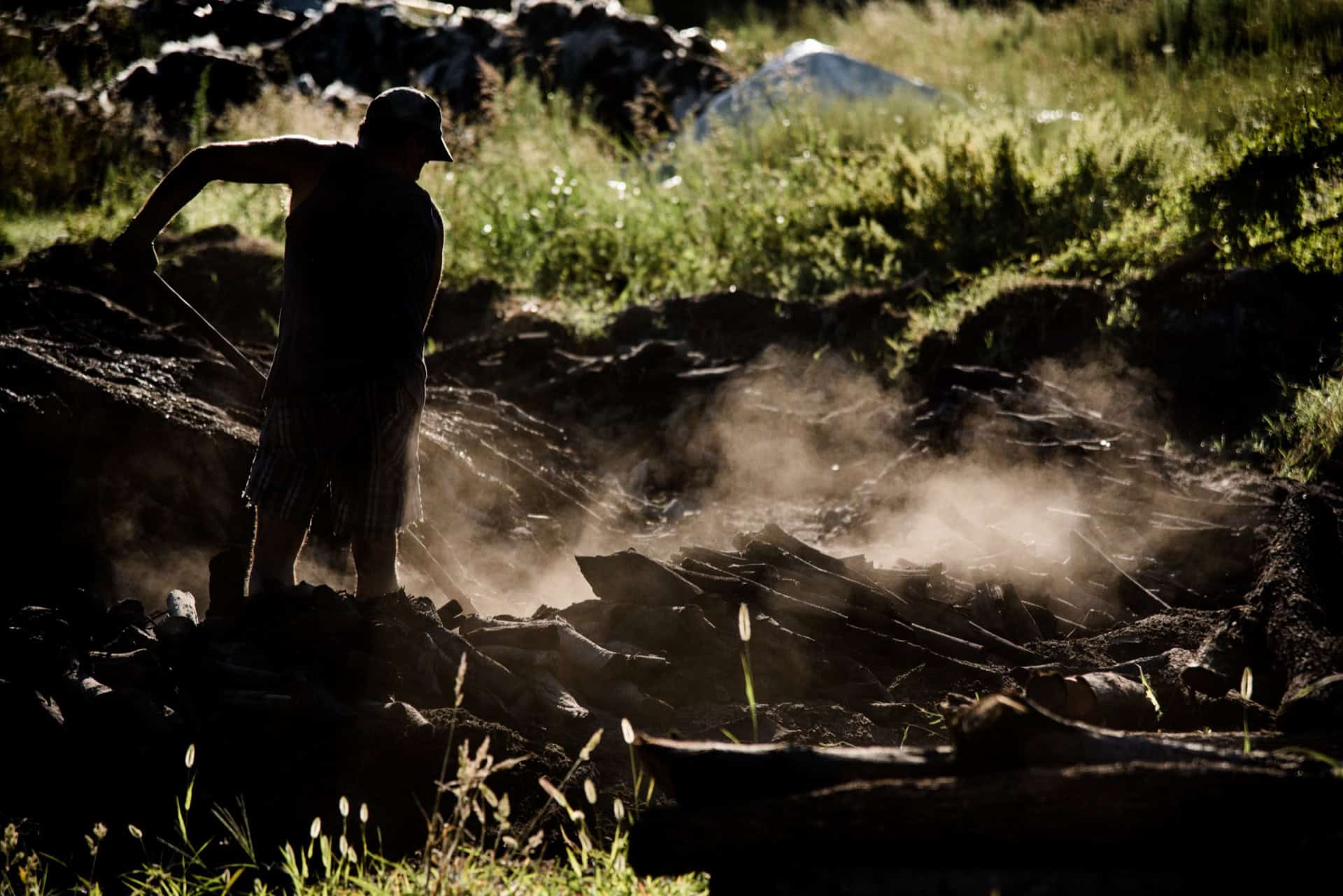
In the mountainous region of Stavros, Thessaloniki, in Sougliani, as the locals call the small peak, smoke rises here and there from clearings scattered across the mountain. The charcoal kilns are now fully operational for the season, and the charcoal makers are rushing to beat the first cold spells and winter dampness. In a place shaped like this, as if created in the style of goth culture, with a strong contrast of black and white, an ancient art has flourished, and it seems to be vanishing there.
Charcoal producers have been making charcoal in Stavros for a century. In the middle of this period, the area accounted for 80% of the country’s total charcoal production. “Now there are only four of us left, plus four Albanian workers, because they’ve known the job for 20 years. Now we produce 5%,” says Antonis Karpouzis, one of the remaining charcoal makers. “This job is dying out too,” adds Theofilos Kokorentzas, pulling out the charred remains of wood, the charcoal, piece by piece from the extinguished kiln. They are covered in soot from head to toe.
“Our grandfathers brought the art from Katerli in Asia Minor. There, it was like Stavros, sea on one side, mountain on the other,” Antonis tells VICE. “There, they used charcoal for the Sultan’s needs; now it’s for barbecues. The art of the charcoal maker is the only one based on traditional methods; no machines are used here,” he continues. “Some, the very small pieces, we give for the incense burners in churches and cemeteries.”

The kilns in Stavros are lit after September 15th, having been prohibited during the summer for tourism reasons, not for fire risk. The charcoal makers say that “fire never started in the forest from the kilns, as we guard them day and night.” Indeed. The charcoal makers stay in huts located next to the mountain clearings with the kilns. They monitor the fire’s progress hourly, though it never truly burns. “The wood isn’t burning, it’s smoking,” explains an old charcoal maker, Zafeiris Bakatsadakis, who stopped working after the restrictions.
The charcoal production process is lengthy. From the placement of the wood—primarily kermes oak—it takes 15 days for the charcoal to form and another five days to “bake” under the nylon that is subsequently placed. “Everything here is done with materials from the earth: soil, straw, water, and wood,” Antonis explains, as if describing the seventh day of creation. “And with old tools: the pitchfork, the shovel, and the rake,” he insists.
In the clearings on Sougliani, the kilns are lit successively, one after another. “The work is difficult,” says Theofilos, who has been working in the kilns for 17 years. The charcoal maker skillfully arranges the wood. They buy it from forest cooperatives, but mainly from Mount Athos, from the monasteries. When building the kiln, the longest pieces are placed first, side by side in a pyramid shape. Shorter pieces are placed on top. This way, a pyramid is built that can reach six or seven meters. At the center of its base, the charcoal makers leave a gap and on one side, a “door,” so they can start the fire. Straw is then spread over the wood. These are the stalks left over from the summer wheat harvest. And the straw is covered with soil to seal it. The goal is for oxygen flow to be absolutely controlled. “If you leave it, it will turn to ash overnight,” Antonis emphasizes. That’s why they watch them day and night.

The burning process of the wood in the kiln is like a ceremony; everything is planned. Mitsos, who has worked with charcoal for 21 years, takes a long iron rod, about two and a half meters. He ties a sack to its end, wraps it, and soaks it with gasoline. “Treat it well so it lights properly,” Antonis advises him. He starts the fire through the “door” and it reaches the heart of the kiln. He pulls out the iron rod and quickly closes the door with straw and soil. He then climbs to the top with a wooden ladder that is permanently on the side of the kiln. He waits for the first smoke to emerge from the hole he left earlier. “It’s going to get smoky here now,” Antonis says, waiting for the thick plume from the initial fire. And as soon as the smoke thickens, the hole is immediately closed.
In the first few days, high up on the pyramid, which has now become a mound, the ‘fousekia’ are opened—small holes for the smoke to slowly escape. Later, when the kiln has progressed, the ‘fousekia’ are closed, and larger holes, closer to the base, are opened. These are the ‘ntipia’. It’s an entire science. And when they see that the kiln is ‘settling’ at some point because some charcoal pieces started forming faster, they have a method. They open ‘bougazia’ at the top—these are also vertical holes—and from there, they drop smaller pieces of wood inside. They ‘feed’ the kiln to balance it and ensure it continues to burn evenly.


If necessary, they occasionally sprinkle the kiln with water. “The wood has its own moisture, and it absorbs as much moisture as needed overnight, and the charcoal becomes just right,” explain the charcoal makers. All this happens when weather conditions are ideal. Rain can disrupt all plans, as the charcoal will not turn out well afterward. Wind creates other problems. “We also know from the fire department if there’s strong wind. We always have to guide the kiln, it’s in our hands,” says Antonis. Everywhere in the clearing, among the five burning kilns and the other four a little further up, fire extinguishers are scattered, just in case. “Once, someone forgot and set fire to the kiln before September 15th. They saw the smoke from the Egnatia highway and thought the forest was burning; we rushed with the fire department to put it out, hosing water from the ‘bougazi’,” the charcoal maker recalled.

The latest innovation was the nylon, which covers the kiln once it’s determined that the process is complete and the wood has turned into charcoal. “The Ikarians brought this art to Stavros; they probably knew best. The charcoal is ready after five days and is full-bodied,” Antonis tells VICE.
The smell of smoke lingers even on Alexandros Avramidis’s camera strap. A kermes oak kiln is ready. It is considered the best wood, and then they also use oak, which is cheaper. The charcoal makers bag the finished charcoal. In every size. “This is ideal for grilling. And it makes a good fire that lasts a long time. But it must be kermes oak. A souvlaki vendor told me, ‘Come eat meat with this charcoal, it enhances the flavor.'”